Building AI Applications with LangChain and TypeScript
Building AI Applications with LangChain and TypeScript
Artificial intelligence applications are evolving beyond simple chatbot interfaces. Modern AI systems can search documents, call external APIs, retrieve information from databases, use tools, and perform multi-step tasks.
LangChain provides a framework for connecting language models with these capabilities, while TypeScript gives developers type safety and a strong development experience for building maintainable applications.
What Is LangChain?
LangChain is a framework designed for building applications powered by large language models (LLMs).
Instead of interacting directly with a model for every feature, LangChain provides reusable abstractions for models, prompts, tools, retrieval systems, agents, and application workflows.
This makes it easier to build applications such as:
• AI assistants • Retrieval-Augmented Generation (RAG) systems • Document question-answering applications • AI agents • Semantic search systems • Customer-support assistants • Applications that interact with APIs and databases
Why Use LangChain with TypeScript?
TypeScript is particularly useful when AI functionality becomes part of a larger web application.
Type safety helps developers define predictable interfaces between application data, tools, model responses, and external APIs.
It also integrates naturally with modern JavaScript frameworks and backend environments such as Next.js and Node.js.
For example, a typical AI application could use:
Next.js → User interface and API routes
TypeScript → Application types and business logic
LangChain → AI orchestration
LLM Provider → Language model
Vector Database → Semantic document retrieval
External APIs → Tools available to the AI
Understanding the Basic LangChain Workflow
A simple LangChain application starts with a model.
The application sends messages or instructions to the model and receives a generated response.
As the application becomes more advanced, additional components can be introduced.
For example:
User Question ↓ Application ↓ Retrieve Relevant Context ↓ Create Prompt ↓ Language Model ↓ Generated Answer
This architecture becomes especially powerful when implementing Retrieval-Augmented Generation.
Retrieval-Augmented Generation with LangChain
RAG allows an AI application to answer questions using information from your own documents or database rather than relying only on the model's existing knowledge.
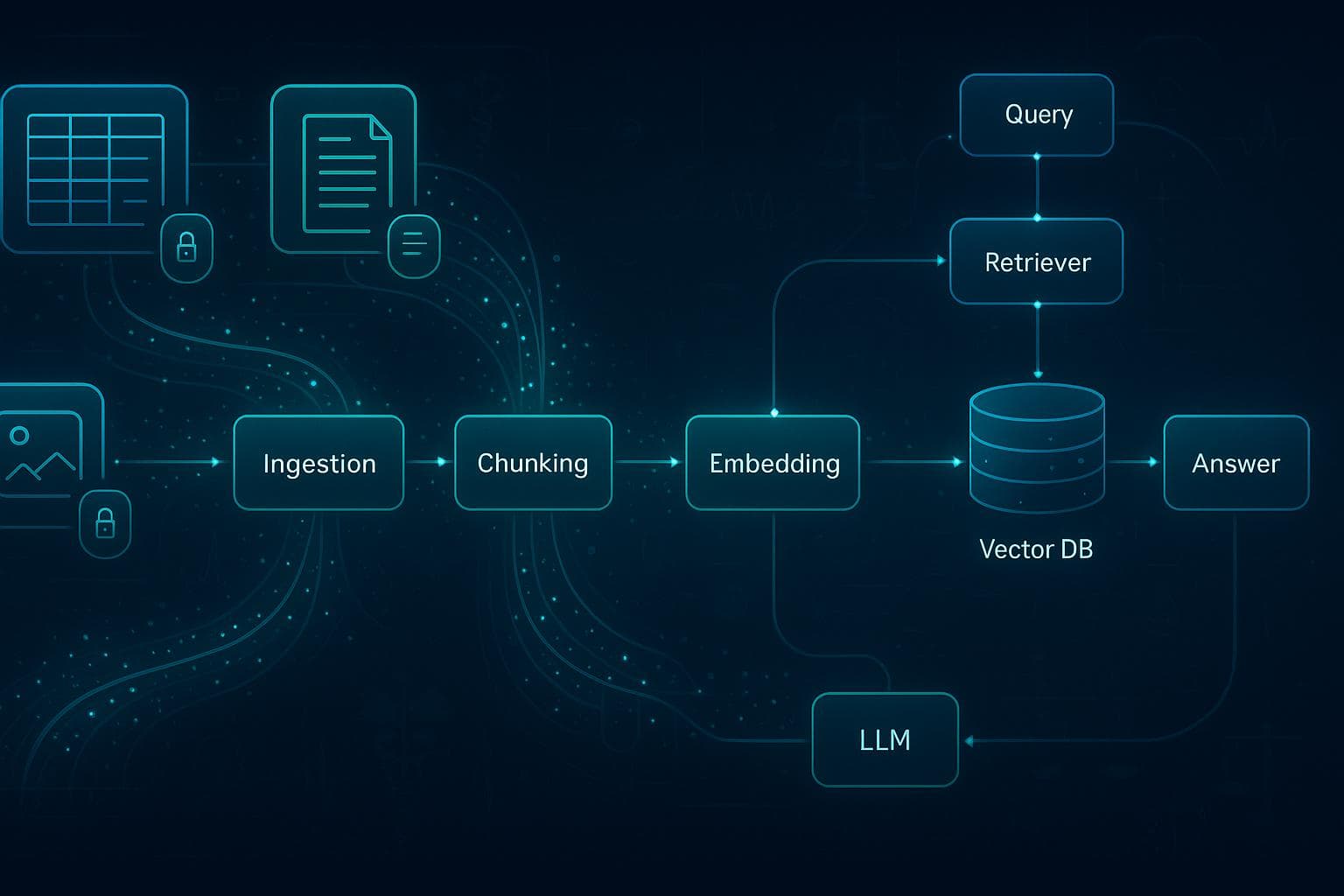
A typical RAG pipeline looks like this:
Documents ↓ Split into smaller chunks ↓ Generate embeddings ↓ Store vectors in a vector database ↓ User asks a question ↓ Generate query embedding ↓ Find similar document chunks ↓ Send relevant context to the model ↓ Generate the final answer
Embeddings represent text as numerical vectors. Semantically similar pieces of text produce vectors that are close to each other, allowing the application to retrieve information based on meaning rather than only exact keyword matches.
Using Tools
One of the most interesting features of modern AI applications is tool calling.
Instead of asking the language model to know everything, we can provide functions that the model can use when necessary.
A tool could:
• Search a database • Retrieve weather information • Send an email • Query an API • Search documentation • Create a database record • Retrieve information about a user
For example, imagine an AI assistant receiving this request:
"What is the current status of order #1052?"
The language model does not need to know the answer.
Instead, it can determine that it needs an order lookup tool, call that tool with order ID 1052, receive the current information, and then generate a natural-language response for the user.
Building AI Agents
Tools become even more powerful when combined with agents.
An agent can analyze a task, determine which tools are required, execute them, examine the results, and continue until it can produce an answer.
The workflow might look like:
User Request ↓ Agent ↓ Choose Tool ↓ Execute Tool ↓ Analyze Result ↓ Choose Next Action ↓ Final Response
This creates applications that can perform more complex tasks than traditional request-response chatbots.
LangGraph for Complex Workflows
As AI applications become more complicated, controlling the workflow explicitly becomes increasingly important.
LangGraph provides graph-based orchestration for agent workflows.
Instead of having one uncontrolled loop, an application can represent different operations as nodes and define how the system transitions between them.
For example:
START ↓ Understand User Request ↓ Retrieve Information ↓ Generate Answer ↓ Validate Answer ↓ END
More advanced workflows can introduce branching, persistent state, human approval, retries, and multiple agents.
TypeScript and Structured AI Applications
TypeScript becomes especially valuable when tools and agents exchange structured information.
Using schemas with libraries such as Zod allows developers to define exactly what data an AI operation expects.
For example, a tool might require:
{ userId: string, query: string }
Instead of passing arbitrary data through the application, schemas can validate inputs before executing important operations.
This becomes increasingly important when AI systems interact with databases, payment systems, user accounts, or other external services.
Production Considerations
Building an AI prototype is relatively straightforward. Building a reliable production AI application requires additional engineering.
Important considerations include:
• Input validation • Authentication and authorization • Error handling • Rate limiting • Streaming responses • Model costs • Observability • Prompt management • Retrieval quality • Tool permissions • Testing and evaluation
AI-generated output should also not automatically be trusted when performing sensitive operations.
For important actions, applications should validate inputs and consider requiring explicit user confirmation.
Where LangChain Fits in a Modern TypeScript Stack
A practical architecture could look like:
Frontend Next.js + React
Backend Next.js API Routes or Node.js
Authentication Clerk
AI Orchestration LangChain
Workflow Orchestration LangGraph
Validation Zod
Database PostgreSQL
Vector Storage PostgreSQL + pgvector
LLM OpenAI, Anthropic, Google, or another supported provider
This architecture separates the responsibilities of the application while allowing the AI layer to interact safely with existing services.
Final Thoughts
LangChain is most useful when an AI application needs more than a single prompt and response.
It provides building blocks for connecting language models with retrieval systems, tools, external data, and agent workflows.
Combined with TypeScript, it becomes a strong option for developers already working in the JavaScript ecosystem who want to build maintainable AI features inside modern web applications.
The important idea is not simply to connect an application to an LLM.
The goal is to design a system where the language model works together with application logic, trusted data, tools, validation, and clearly defined workflows.
That is where frameworks such as LangChain and LangGraph become especially useful.